River in Magadan Oblast, Russia

ff61ee360a439a0607be80f1330767f6.jpg

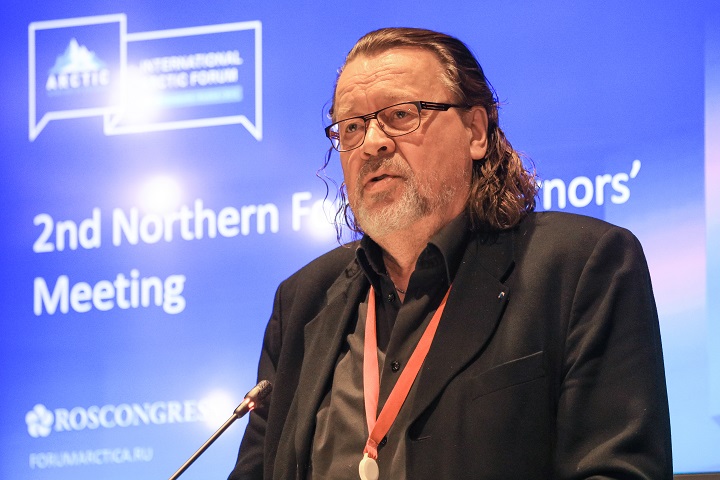
«Scientists have to work together, because if we learn something, we should know how to manage different natural systems together. It's a complicated situation right now, and the most important thing we can do is to realize that once this is over, once the conflict is resolved, we can start working closely together again. We have to keep that in mind all the time».


Paul Fuhs,

President, Chairman of the Board at Marine Exchange of Alaska, Member of the Arctic Economic Council commissions

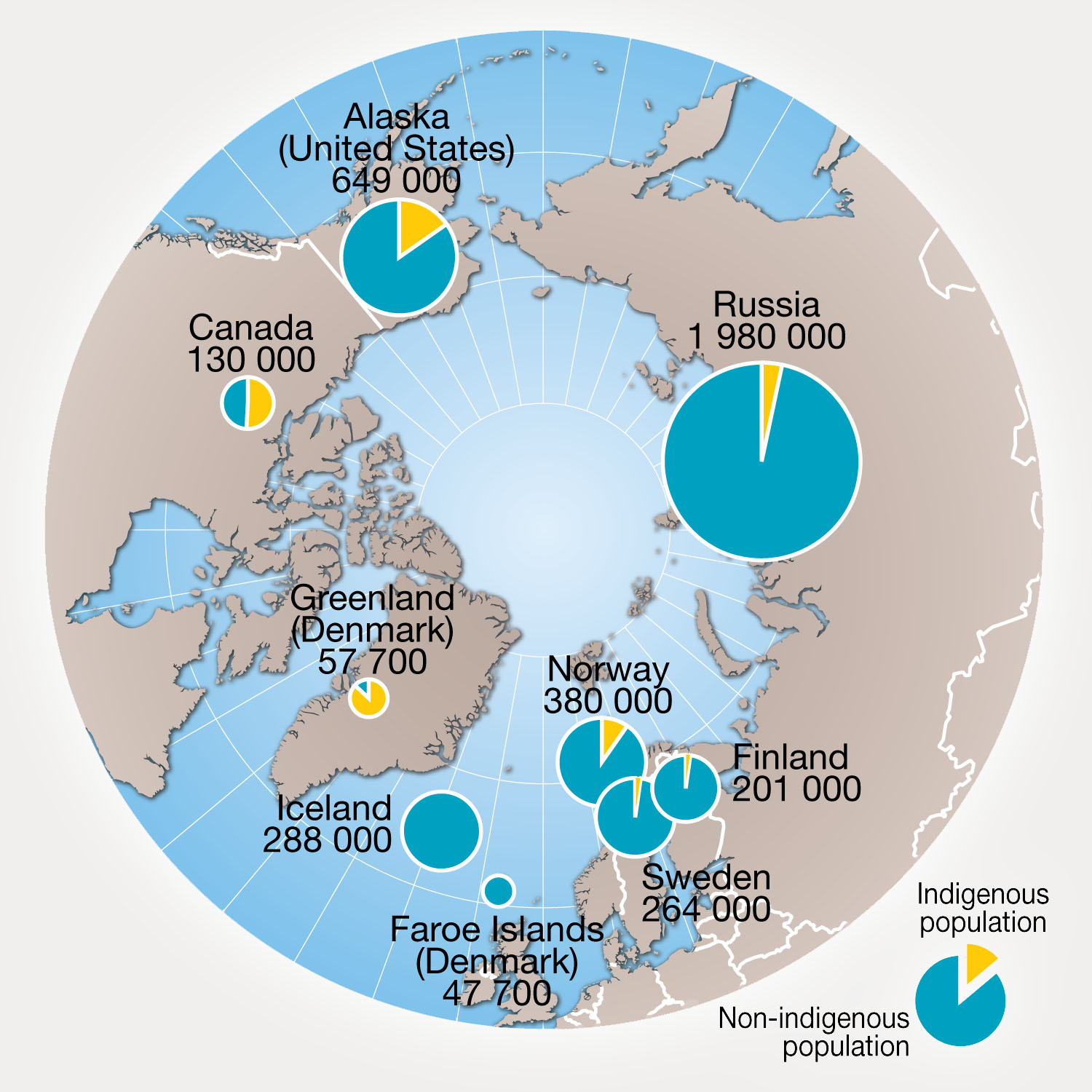
Distribution of indigenous population in the Arctic
(Map: The Arctic Human Development Report - 2004) Distribution of indigenous population in the Arctic.

The Arctic covers 40 million square kilometers or approximately 8% of the Earth´s surface, but hosts a population of only 4 million. Of the 4 million, various small groups of indigenous people, peoples who occupied the area long before the people of European tradition came, can be found.

Almost all of them live today as a minority within the borders of contemporary nation states.

Only in Greenland, the indigenous are in majority as they account for 88% of the entire population. In the same time half of the northern Canadian population is indigenous.
In Scandinavia and north-Russia, indigenous peoples are only a small fraction of the population or around 4-5%, Alaska having an indigenous population of around 20%.


Despite that some 40 indigenous languages are still spoken in the Arctic, Russian, English and Scandinavian languages are the most dominant languages today. Only in Greenland is Inuktitut, an indigenous Inuit language, the only official language of the region. In addition, Canada recently approved Nunavut's proposal to declare Inuktitut, English and French the official languages of Nunavut.


There have been inhabitants in the Arctic for at least 12.000 years according to bones found in Russia. Some believe people have lived up North for much longer or up to 30.000 or 40.000 years, no-one knowing for sure.


(Photo: Andy Mahoney) For transportation, people in the arctic often travel by sled pulled by a pack of huskies. Little is known about the earliest people from 12.000 years ago, but the culture and livelihoods of the Inuit and the Saami, from around 4500 years ago, are better known and archived. The first Inuit, the Paleo-Eskimos, emigrated from Asia to Alaska crossing over the Bering Strait.


They lived off the land, hunted seals, walrus and perhaps even whales also hunting reindeers and musk oxen, birds and polar bears. Around 2500 years ago life shifted slowly but surely while the Arctic got colder. The Paleo-Eskimos gave it away for the Dorset Culture. The Dorset people stretched skins over a simple wooden framework to make kayaks and tents. Stones held down the skins on the tents but in the cold hard winters, they lived in caves, turf houses or snow houses. For food, they hunted whales as big as beluga and narwhal.


This culture lived for around 2000 years, when the Thule people became the new tradition. They are the forerunners of the modern Inuit. The word Inuit means The People and is plural, while Inuk is a single person. Eskimo on the other hand is considered derogatory as a name for Inuit's, as in Inuktitut Eskimo means "eaters of raw meat".


Like their processors, Inuit used tents made out of skins and wore skin for clothing. These are traditions Inuit are proud of and even today, in 2011, they wear clothes like their ancestors.


Inuit's developed extensive hunting skills in the Arctic using harpoons with a handle and a rope attached to it to kill seals and whales. That way the pray did not sink when killed, or wounded. Inuit used dogsleds (at first wolf sleds) to move around and to hunt. They used a bow and arrow and shot polar bears and other animals. Inuit's trusted on caribou and whales to migrate, if they did not their price was starvation.


The Saami originated from the Urals in Asia, like so many tribes from the area. They have inhabited the northern Arctic and sub-Arctic regions of Fenno-Scandinavia and Russia for at least 5000 years living off of the reindeer husbandry and fishing.
18 Mar 2026
The Northern Forum participates in Arctic Council's EPPR Working Group meeting

On March 18, The Northern Forum took part in the plenary meeting of the Arctic Council's Working Group on Prevention, Preparedness and Response to Emergencies (EPPR).

News
18 Mar 2026
The Northern Forum strengthens ties with the USA: Peter Clark's visit and plans to publish a book about ALSIB

On March 18, the Secretariat of The Northern Forum was visited by Peter Clark, an American of Yakut descent, and his wife Katerina. The meeting focused on promising projects aimed at strengthening [ ... ]

News
17 Mar 2026
The Northern Forum Director Vladimir Vasiliev and leadership of Anabarsky District discuss ecotourism development

On March 17, a working meeting took place between the Director of The Northern Forum, Vladimir Nikolaevich Vasiliev, and the leadership of the Anabarsky National (Dolgan-Evenki) District (Ulus). [ ... ]

News
16 Mar 2026
The Northern Forum Working Group on Transport and Logistics (chaired by Nadezhda Filippova), together with ZVEZDA LLC (lead developer Alexander Blokhin), is implementing the Mobile Expeditionary Northern Arctic Lecture Series named after Vladimir Alexandr

The Northern Forum Working Group on Transport and Logistics (chaired by Nadezhda Filippova), together with ZVEZDA LLC (lead developer Alexander Blokhin), is implementing the Mobile Expeditionary Northern [ ... ]

News
13 Mar 2026
ARCTIC IN AN ERA OF CHANGE

On March 13, 2026, the Project Office for Arctic Development (PORA) in Moscow hosted an off-site event of the Northern Forum on Sustainable Development — a joint expert session titled "Arctic in an [ ... ]

News
13 Mar 2026
On March 13, Moscow hosted the first off-site event of the Northern Forum on Sustainable Development,

On March 13, Moscow hosted the first off-site event of the Northern Forum on Sustainable Development, "Arctic in an Era of Change." RACAR was represented by Alexander Kugaevsky, who spoke at the session [ ... ]

News

Upcoming Events

Disclaimer

The events list is provided as an non-parcial overview of upcoming events in and about the Arctic and the North, for the interest and benefit of all stakeholders.
The events listed and their administration are the responsibility of the individual events organisers.
All content on the events website, a link may be provided to through this events calendar, is the sole responsibility of the individual organiser.


Members of the Northern Forum

7th Northern Sustainable Development Forum

II half of 2026
Yakutsk, Russia

COP31 ARCTIC PAVILION

II half of 2026
Antalya, Turkey

Board of Governors
Regional Coordinators Committee (RCC)
Business Partners
Goodwill Ambassadors
Northern Youth Forum

The Northern Forum Schools Association

The Northern Forum Schools Association an interregional association of secondary general education organizations of the Northern Forum member regions, as well as the regions interested in cooperation with the northern and Arctic regions, and is a structural subdivision of the International Organization of Northern Regions "The Northern Forum".